
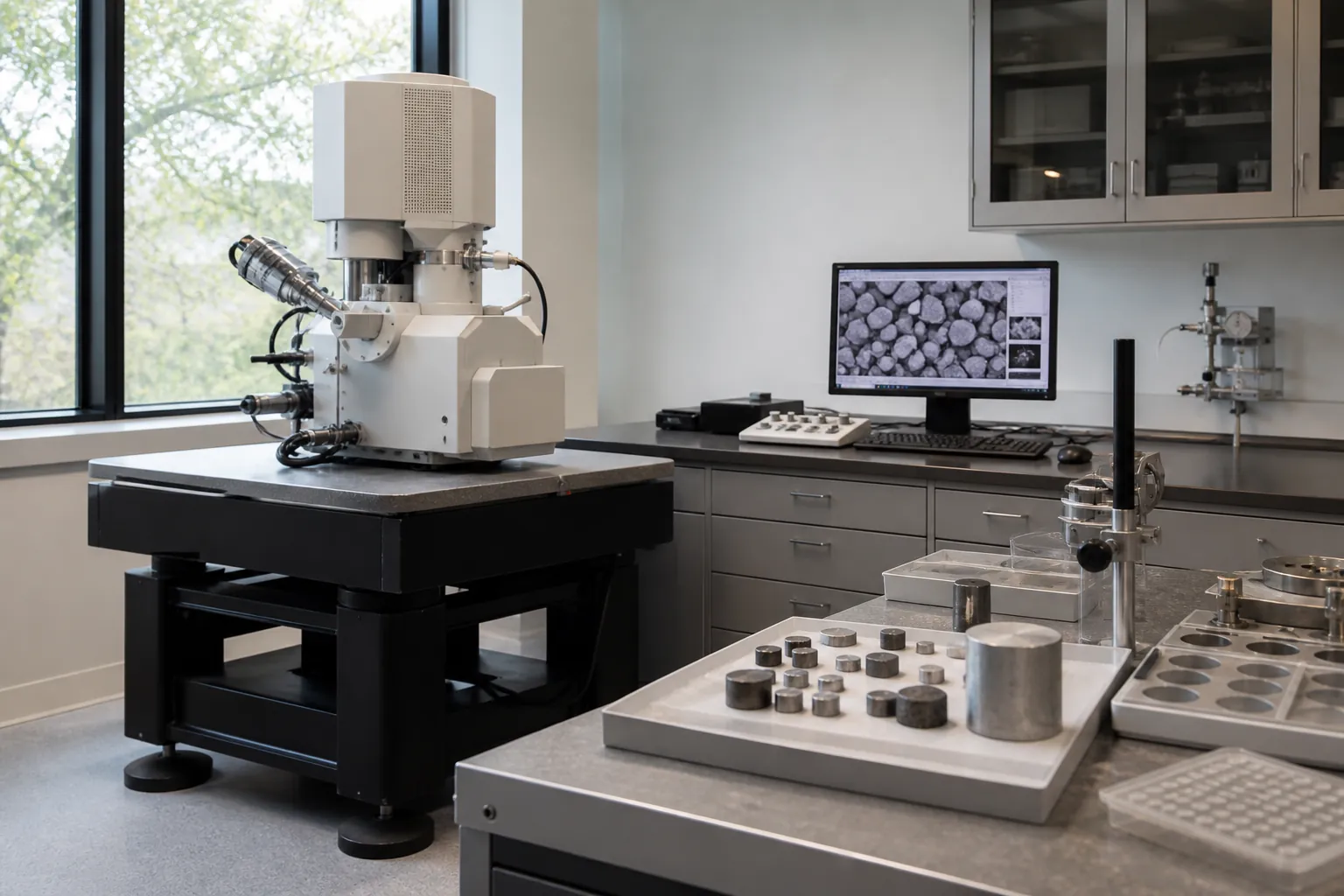
Supporting high-quality research and education in the field of advanced materials
SRCAM Overview
The Scientific Research Center for Advanced Materials (SRCAM) is a key hub for research in materials development and innovation both in the United States and globally. It aligns with global strategic priorities, including improving electronics and communication systems’ performance and advancing medical and clean energy technologies.
The center is established to enable innovative environment with advanced equipment and support facilities which will minimize barriers to research output while uplifting local research standards to global levels. The center will support interdisciplinary research and innovation culture while promoting collaborative research activities with industry partners. SRCAM aims for development of a quality intellectual property pool through high quality publications, IPs and technology transfer.
SRCAM consists of a well-experienced team of consultant scientists, who excel in a vast array of scientific domains. We provide unique consultation services to industries within United States and globally in sectors related to material chemistry-based industries such as latex-based industries, rubber industry, plastic industry, paint and coating industry, textile industry, agrochemical industry, natural product-based industry, graphite industry, as well as in the areas of environmental remediation, development of sensors, and preparation of insect repellant materials.
The center aims to become a distinguished research center and actively contributes towards the advancement of material science through innovative research techniques, unwavering commitment to academic excellence, and industry partnerships.
SRCAM conducts interdisciplinary research projects that exceed traditional academic boundaries, reflecting the dynamic and diverse nature of materials science. Our team of distinguished scholars and scientists brings together expertise from various academic disciplines, including material science, chemistry, physics, and biology.
The Scientific Research Center for Advanced Materials (SRCAM) collaborates with leading universities and research institutions in the United States and abroad. Additionally, it works with industry partners to ensure the commercialization and application of new materials in industries including electronics, health care, and energy. It uses advanced technologies such as artificial intelligence, machine learning, and big data analytics to accelerate the discovery and development of new materials.
Furthermore, SRCAM serves as a platform for teaching, training, and research, nurturing a collaborative environment where students and researchers from various disciplines – such as physics, chemistry, biology, materials science, computing, and engineering – work together on cutting-edge projects. By combining expertise and resources, the Center tackles complex challenges in materials research and development, pushing the boundaries of scientific knowledge to benefit society globally.
Research activities range from blue-sky research to the translation of results into industrial processes, with a focus on creating new materials that can have large scale applications in manufacturing, healthcare and consumer products.
The center has four unique research themes: energy materials, healthcare materials, 2D materials technology, and materials for sustainable applications.
Materials for Sustainable Applications
- Materials for water desalination
- Capturing and conversion of greenhouse gases
- Membranes for water filtration and purification
- Materials from renewable sources
Wearable Device Materials
- Opto-electronic materials
- Electro-chromic materials
- Materials for sensors
- Wearable devices
Energy Materials
- Materials for wind turbine blades
- Hydrogen storage materials for fuel cell applications
- Solar energy harvesting
- Electrode materials and structures for energy storage devices; batteries and supercapacitors
- Piezoelectric and thermoelectric materials
Graphene and other 2D Materials
- Materials for implants: bones, hip, joint replacements
- Materials for medical devices
- Thermal interface materials
- Dental materials
- Advanced composites
Mission
- To be a leading national center, recognized globally, for impactful research in advanced materials that leads to innovative and practical solutions.
- To engineer materials with novel properties that enable superior performance in technological applications for energy, oil and gas, defense, water desalination, chemical and petrochemical, metals, construction, automotive, packaging, and other strategic national sectors.
- To create a stimulating and advanced environment to conduct qualitative and innovative research, develop research capabilities and products, and enhance scientific and technical skills in the fields of advanced materials research.
- To provide an enabling innovation environment with advanced equipment and support facilities
- To initiate and encourage opportunities for interdisciplinary materials research
Vision
- To establish an innovative arena for advanced material research in the United States and globally
- To achieve excellence and leadership in advanced materials sciences and their various applications according to international standards and benefiting from them locally and regionally.
- To become a national center of excellence for advanced material research and actively contribute to advancing materials research at regional and international levels.
Strategic Objectives
The objectives of the SRCAM are to:
- Carry out research, development and innovation in science and technology with criteria of excellence in the areas of materials, energy and environment with the aim of boosting the country's development.
- Establish a comprehensive research program in materials science including synthesis, characterization, processing, and applications of advanced materials
- Provide technological and innovative solutions to the productive, academic and social sectors through services, assessments, consulting and generation of technological development.
- Build a research infrastructure with advanced laboratories, specialized equipment, and computational resources to support cutting-edge research
- Recruit and retain talented researchers and students from diverse backgrounds and disciplines to foster an inclusive and collaborative research environment
- Form high-level human capital in the areas of specialization through postgraduate studies programs.
- Promote education and training through workshops, seminars, and courses to disseminate knowledge and skills in advanced materials research.
- Establish partnerships with industry and government agencies to support research and development activities and facilitate technology transfer and commercialization of research results; and
Goals
- To activate the most important possible research strategies to develop and evaluate advanced materials science and technology and to establish specialized units to find applied scientific solutions to major issues that have a direct impact on society in United States and the world.
- To process and synthesis of advanced materials and structures.
- To develop both field characterization techniques and in-situ monitoring for the microstructural and the effective behavior of advanced materials and structures.
- To provide research opportunities for IIU undergraduates during the academic year and providing opportunities for summer research experiences.
- To motivate, inform, and stimulate interest through participation in seminars, workshops, symposia and conferences.
- To form multidisciplinary research teams in the fields of chemistry, physics, engineering, biology, environmental and medical sciences to enhance cooperation between them.
- To provide financial and technical support for outstanding graduate student research related to the center’s field.
- To hold conferences, training courses and specialized workshops for researchers in the field of advanced materials technology.
- To enable faculty members and researchers at the university and the community to produce distinguished research and publish it in scientific journals with high impact factors, besides producing new materials that are registered as patents that can be invested.
- To facilitate technology transfer to support the national industry to compete in the global market by developing new and approved petrochemical products in materials science.
Research
The SRCAM has identified the following research and programs, represented as research and programs divisions, during its initial development.
Research
1. Research division on Information Materials.
It concentrates on areas leveraging IIU resources and expertise, supported by hiring and content development at undergraduate, postgraduate and PhD levels. Potential areas of focus are:
- Artificial intelligence hardware.
- Advanced nanofabrication techniques and
- Advanced materials for semiconductor devices.
2. Research division on Dual Carbon Strategic Materials.
It focuses on advancing the understanding of materials science and engineering by studying new materials and their properties through techniques like simulation and experimentation. Potential areas of focus are:
- Biomaterials
- Sustainable materials
- Additive manufacturing of materials
- New energy materials and
- Catalytic materials.
3. Design of Materials. Multi-Scale Computation, Simulation
Simulations and modeling will be employed to guide the experimental work as well as exploring new potential and properties from emerging materials.
The need for extraordinary accuracy in predictive modeling of the behavior of materials is rapidly gained prominence in fields such as electronic materials, where combinations of dissimilar materials generate defect mediated failures at the angstrom level.
This theme aims to develop a leading group of researchers, based in academia, in modeling and simulation of materials.
4. Research division on Frontier New Materials.
To align with the fundamental research and programs conducted within the SRCAM. Potential areas of focus are:
- Quantum computing materials: investigating and designing materials with tailored quantum properties for the development of quantum computers and quantum information processing
- Nanomaterials in catalysis: exploring nanomaterials’ catalytic properties for sustainable chemical reactions and processes
- Nanomedicine: exploring nanomaterials for targeted drug delivery, diagnostics, and therapeutics in healthcare and personalised medicine
- Graphene-based technologies: researching the use of graphene in energy storage devices, flexible electronics, ultrasensitive sensors, and advanced materials due to its exceptional electrical conductivity and mechanical strength
- Quantum materials for energy: investigating materials with quantum properties for more efficient energy conversion and storage solutions, including quantum dots for photovoltaics
- Superconducting materials: exploring novel superconducting materials that operate at higher temperatures to enable practical applications in power transmission and medical imaging
- Nanoelectronics: exploring novel nanoscale materials and devices for high-performance transistors and sensors and other electronics, such as nanowires, nanotubes, and 2D materials like graphene; and
5. Biomaterials and functionally graded materials
This initiative features new research activities to develop fibre-polymer functionally graded materials and hydroxyapatite biomimetic coatings, ceramic matrix nanocomposites and metal-ceramic functionally graded materials for the Aerospace industry and Biomaterials industry.
6. Theoretical and applied fracture mechanics
Here we cover interface fracture of fibre/matrix system, damage of polymer alloys and blends, microstructure-toughness relationships of polymers, constitutive modeling, micro-damage and micro-crack propagation, failure mechanisms of piezoelectric materials, fatigue, effects of crack tip constraint and mismatch of adhesive joints geometry.
7. Composites science and technology
8. Nanomaterials
This field features a new class of engineering material consisting of nano-meter scale particles or fillers. Our research focuses on processing and characterization of the structure-property relationship of several typical polymer-based, metal-based and ceramic-based nano-composites to understand the deformation and failure mechanisms.
9. Nanomechanics and nanotribology
With the rapid development in applications of high-density information storage devices, micro-electro-mechanical systems, biomedical devices and wireless and fibre optic communication systems, the importance of nanomechanics and nanotribology is paramount. Our current research activities focus on the mechanical analysis of nanomaterials including carbon nanotubes, mechanisms nanowear and the effect of nano-cracks and shear bands.
10. Structures with embedded intelligence and multi-functionality
Our focus here includes embedded intelligence and multi-functionality, enabled by active-sensor network and micro-/nano-technology for structural self-diagnosis and assessment, self-healing with simultaneously improved damage resistance and tolerance.
11. Smart materials and structures
We build 'smart' structures using active materials such as shape memory alloys/polymers, piezoelectric ceramics and polymers, and magnetostrictive composites. Our research includes development and characterization of novel active materials with improved performance, development of active structures with surface mounted/embedded sensors/actuators for vibration and damping control and on-line health monitoring or non-destructive evaluation.
12. Transport engineering
We’re at the forefront of multidisciplinary research, advancing fundamental knowledge and engineering practice through transport science, engineering, and policy approaches to create efficient and equitable transport systems.
Transport is central to economic activity and to our lives; it enables us to engage in work, attend school, shop for food and other goods, receive deliveries and participate in everyday activities.
Transport questions require design thinking beyond traditional disciplinary boundaries. Infrastructure is traditionally associated with civil engineering, whereas vehicles are anchored in mechanical engineering and services in the domain of business. These domains come together to address big problems like congestion, pollution, safety and accessibility.
Key Areas of Research
12a. Traffic operations and control
Traffic operations are essential for managing congestion and supporting economic productivity. Building on control theory, traffic flow theory and empirical approaches, we contribute to theoretical and practical traffic operations.
12b. System impacts of autonomous vehicles
The emergence of autonomous vehicles has wide-ranging impacts on the transport system. We’re looking at performance dependencies in the transport system as these technologies reach saturation.
12c. Traffic operations and control
12d. Transport system performance measures
Increasing availability of data and a refocusing on the customer have led to new approaches to transport system performance measurement. We leverage new data sources and econometric approaches to benchmark status quo performance and model interventions.
Our Research Strengths
Materials Characterization
- A full spectrum of analytical tools including electron microscopy (SEM, TEM), atomic force microscopy (AFM), powder X-ray diffraction, single crystal X-ray crystallography and a range of thermal and mechanical analysis instruments.
Materials Synthesis
- Biocompatible materials.
- Fine particle synthesis, surface modifications and dispersions.
- Materials and structures for energy conservation and solar devices.
- Smart materials.
- Thin and thick film coatings.
- Functional polymer materials.
Materials Processing
- Anti-corrosion technology.
- Additive manufacturing using metals and alloys.
- Film deposition methods for metals, alloys and dielectrics.
- Chemical mechanical polishing.
Materials – Computational Methods
- Finite element analysis (FEA) of structural materials.
- Models and simulations for fine particle dispersions in air and/or fluids.
Programs
i. Event
1. Scientific Research in Advanced Materials for Sustainable Development (SRAMSD)
The Scientific Research Center for Advanced Materials (SRCAM) will organize Scientific Research in Advanced Materials for Sustainable Development (SRAMSD). Sustainable development is the development that meets the needs of the present without compromising the ability of future generations. The focus would be on the developments of material science and technology for achieving sustainable development, especially by covering different branches of material sciences.
Objectives:
Identifying the emerging opportunities for sustainable developments in the areas related to Energy, Environment, Food, Health, and Building
Theme:
Scientific Research in Advanced Materials for Sustainable Development (SRAMSD)
Key Topics:
- Drugs and Pharmaceuticals
- Construction and Building Materials
- Green Photocatalysis
- New and Renewable Energy Materials
- Food Production and Safety
- Materials, Technologies, and Devices
The SRAMSD will held in conjunction with International Conference on Nanotechnology and Smart Materials. The conference aims to foster collaboration and knowledge exchange among scientists, researchers, and industry professionals working in the fields of nanotechnology and smart materials. This conference will provide a platform to showcase the latest innovations, explore emerging trends, and address key challenges in these rapidly evolving fields.
ii. Training
SRCAM provides a first-class training environment for postgraduate and postdoctoral scientists. The center will provide industry with the blend of skills required to meet current and future demands in developing and establishing advanced materials and processes for practical application through a mixture on initiatives including :-
a. Postgraduate Training
PhD Studentships for our own research programs and within the other research projects are usually available.
b. Graduate training and career and professional development
Training Courses either at SRCAM or in-house that can be specifically tailored for your needs.
c. Technology Transfer
There are opportunities for member companies to work in SRCAM research laboratories to ensure smooth technology transfers.
d. KTP (Knowledge Transfer Partnerships)
This scheme can be utilized to train and develop your own in-house advanced materials expertise in all different branches at modest costs.
e. Secondment
The SRCAM has resource allocated to attract scientists from industry who wish to carry out fixed term secondments to acquire advanced training and skills in specialist areas that can be tailored to meet your needs.
SRCAM Facilities (Proposed)
SRCAM Proposed Facilities for the Center are
- Transmission Electron Microscopy (TEM)
- New Flourometer
- Two FT-IR Spectrophotometers
- 400 and 600 MHz Brucker NMR machines
- EPR machine
- Spectrophotometer with reflection attachment
- Scanning Electron Microscopy (SEM)
- A Number of GC Chromatograph
- Cryostat (He & N)
- Vacuum thermal evaporation units
- X-ray diffraction (XRD)
- Elemental Analyzer
- Mass Spectrometry (EI)
- Normal and vacuum ovens
- Sputring Machine
- Atomic Absorption Spectrometer
- Thermoelectric power and Hall effect
- Surface Area and porosimetry Analyzer
- GC-Mass Spectrometer
Partnership
Our Partners
Our business partnerships, including collaborations with other companies, academic institutions, and research organizations, play a critical role in helping us achieve our research objectives. By working together, we can leverage each other's strengths, resources, and expertise to conduct high-quality research and deliver valuable insights to the society. We are committed to maintaining strong relationships with our partners and exploring new partnerships that can help us expand our research capabilities and deliver even greater value.
Our Collaborations
SRCAM is a leading research center based on innovations and collaboration opportunities with local and foreign research centers. This is achieved through the laboratory's technology transfer, commercialization and partnership efforts, which are focused on scientific advances in areas such as health, energy, environment and security.
We recognize the value of partnering with various entities from innovative startups, industries, to government agencies and research centers/universities. Collaborating with them extends opportunities and allows us to achieve goals most effectively.
We eager to join forces with partners to stimulate innovation and progress for the benefit of society.
Please, let’s discuss how we can collaborate with you!